Showing posts with label Turkey. Show all posts

Wednesday, July 23, 2025

Traditionalism in Turkish cultural life: for further investigation

A new open-access article points to a possible new direction in the study of the impact of Traditionalism on twentieth-century Turkish cultural life. It is Büşra Çakmaktaş, “From Cinema to Sufism: The Artistic and Mystical Life of Turkish Screenwriter Ayşe Şasa (1941–2014),” Religions 2025, 16, 787, available here. 

Çakmaktaş writes that the Turkish film-maker Ayşe Şasa (1941–2014) read Guénon and Lings, and “frequently referred to the works of these intellectuals… and adopted their metaphysical and spiritual perspectives on Islam as a guiding framework for her artistic works.” The article does not give any examples of this, however, and instead points to general “Sufi” influences on Şasa and her work, deriving from Ibn Arabi and Rumi. Şasa was a Jerrahi, attending the Istanbul tekke led by Safer Dal (1926–1999), the successor of Muzaffer Ozak (1916-1985), who made a big impact in the West through his visits to New York in the 1980s.

The writings of Şasa cited by Çakmaktaş are Yeşilçam Günlüğü (Yeşilçam Diaries, 1993) and Delilik Ülkesinden Notlar (Notes from the Land of Madness, 2006). In Yeşilçam Günlüğü, a long passage is quoted from Lings' What is Sufism  on “the correspondence between inner and outer vision, and between signs in the material world and divine meanings.” “This field offers untouched treasures for cinematic interpretations based on a metaphysical understanding,” wrote Şasa. In Notlar, Guénon is cited four times, mostly as saying that knowledge of the infinite is the only true knowledge, but also as ascribing the crisis of the modern world to the loss of traditional civilization, a proposition with which Şasa explicitly agrees.

These two books certainly indicate familiarity with the Traditionalists, but not exactly their use “as a guiding framework.” More research is needed.

Tuesday, May 23, 2017

New book on Eurasianism in Turkey

A new book on Eurasianism in Turkey has just been published, The Foreign Policy of Modern Turkey: Power and the Ideology of Eurasianism, by Özgür Tüfekçi (London: I. B. Tauris, $95).

Tüfekçi understands “Eurasianism” broadly, as the idea that Turkey should turn towards Russia rather than the West. He starts off in the nineteenth century, moves on to the period of Turgut Özal (1983-1993) and then to the present day, to Doğu Perinçek and the İşçi Partisi (IP, Workers' Party) and Alexander Dugin, a relationship already mentioned on this blog.

I have not yet been able to look at the book itself. The chapter titles look a bit clunky. But the long view may be interesting.

Sunday, February 05, 2017

Another book on Eurasianism

Alexander Dugin and Traditionalism are discussed in a new collection edited by Mark Bassin and Gonzalo Pozo, The Politics of Eurasianism: Identity, Popular Culture and Russia's Foreign Policy (London: Rowman and Littlefield, 2017).

The book takes "Eurasianism" in its widest sense, and Dugin's Eurasianism--what some call "Neo-Eurasianism"--is thus only one of the topics considered.

The book is divided into four parts.

  • Part I, on "Eurasianism, Nationalism and Ideology," contains three chapters discussing Eurasianism in general terms. 
  • Part II, "The Cultural Politics of Eurasianism," contains three chapters looking at the status of Eurasianism in post-Soviet Russian life, as "alternative history" and in movies. 
  •  Part III looks at "'Project Eurasia' and Russia's Foreign Policy," and contains four chapters. Marlene Laruelle asks how Eurasianism sees China,  Gonzalo Pozo looks at the Eurasian Economic Union, Anton Shekhovtsov looks at "Aleksander Dugin's Neo-Eurasianism and the Russian-Uranian War," and Richard Sakwa looks at whether Eurasia really exists. 
  • Part IV looks at Eurasianism outside Russia: In Tartarstan (Victor Shnirel’man), Hungary (Balázs Trencsényi), Turkey (Emre Erşen), Kazakhstan (Luca Anceschi) and Germany (Ian Klinke on Alexander Rahr). 
Traditionalism is discussed explicitly only by Balázs Trencsényi, who notes its importance for the post-1980s alternative intellectual milieu in Hungary that drew on the work of Béla Hamvas, and the importance of this milieu and of Traditionalism for the Jobbik leader, Gábor Vona. This, in the view of Trencsényi, is one reason why Vona and Dugin see eye to eye. Another reason, he suggests, is that there is some evidence of Russian financial support for Jobbik. Trencsényi, incidentally, wrongly identifies Guénon as "an adherent of fascism."

Dugin is discussed especially by Shekhovtsov and by Erşen. Shekhovtsov shows that Dugin has long argued for the division of the Ukraine, explicitly in Foundations of Geopolitics (Основы Геополитики, 1997), but it is not clear to what extent he has actually played an important role in the recent Russian intervention. As Shekhovtsov reminds us, members of the Eurasian Youth Union (Евразийский Союз Молодежи, ESM) were early supporters of the secession of eastern Ukraine and established several branches there, but after their role in the spectacular destruction of Ukrainian national symbols atop Mount Hoverla in 2007 (see blog post), they suffered a split, were targeted by the Ukrainian security services, and declined in Ukraine. Other secessionists remained on good terms with Dugin, however, and when secessionism re-emerged after 2014, Dugin supported secession in his public pronouncements, and also encouraged ESM members to volunteer for action. So, however, did many other groups, and thus, as Shekhovtsov says, it "seems impossible to establish how successful or efficient the ESM was in recruiting the volunteers."

Interestingly, Shekhovtsov refers to a report by the Center for Economic and Political Reform, a Russian NGO, which shows Russian state financial support for the ESM (report available here). Dugin is often said to be close to the Russian state, but this is just as often disputed. Financial support for the ESM is evidence of a good working relationship. Sakwa, however, argues that Dugin’s "influence on Russian regime politics has been minimal" and notes that after his “militant and uncontrollable support for the insurgency in the Donbass," the Russian regime “fought back to control the monster of Russian nationalism." This makes sense: the Russian government undoubtedly wishes to use nationalism and Eurasianism, not be be used by it.

Erşen also considers Dugin's influence in Turkey. He covers familiar ground, and makes an important point: that while Dugin's anti-Westernism easily finds an appreciative audience in today's Turkey, his pro-Russianism does not.


Thursday, November 03, 2016

CounterPunch attacks Maryamiyya

An article on the Maryamiyya has just (November 2) been published in CounterPunch, "the fearless voice of the American Left," which "tells the facts and names the names."

The article, "Sufism in the Service of Empire: the Case of the Maryamiyyah" by the Berlin-based Iranian intellectual Wahid Azal, focuses on the Maryamiyya's influence today, after presenting Frithjof Schuon and the Maryamiyya (with an emphasis on the most problematic details in its history) by way of background. The names that Azal names are Prince Charles, Ibrahim Kalin (President Erdoğan's press secretary and associate), Prince Ghazi of Jordan, and Alexander Dugin. He refers to Maryami influence in Morocco, the Gulf, and Saudi Arabia, but without naming names. He then also names names within "the Islamic/Mid East Studies establishment of the Western Ivory Tower" (William Chittick, Terry Moore, Hasan Awan, Reza-Shah Kazemi and Alan Godlas) and in Iran (Gholamreza Avani).

Azal's conclusion is that while Sufism has historically often opposed colonialism and empire, "Western... Sufism has increasingly gone in another direction, allying itself more and more with the agendas of Western establishments and the core interests of Empire in the Muslim world." This, in Azal's view, is true of the Naqshbandi-Haqqani Sufi Order as well as to the Maryamiyya, and is "as big a betrayal of the ‘Tradition’ as Islamism itself is."

Azal is right about the alliance between much of Western Sufism and Western establishments, though I am not sure about the "core interests of Empire," as I am not sure that "Empire" is a the right way to describe the West today, and as I am also not sure that the West really knows what its core interests in the Muslim world are, which may actually be part of the problem.

I think what really explains the alliance between much of Western Sufism and Western establishments today is the familiar logic that makes a friend of my enemy's enemy. Western Sufis are invariably hostile to Islamism, Salafism and so on, which is generally hostile to them. The so-called Islamic State, for example, has also denounced the Naqshbandi-Haqqani Sufi Order, for its theology and for being "quick to ally with any tāghūt [idolators] who will allow them to spread their message," the main idolators being the Americans (Dabiq 14, Rajab 1437 [April 2016], p. 15).

Shared hostility to Islamism and Salafism places much of Western Sufism and Western establishments on the same side. To what extent this is "a betrayal of the ‘Tradition’" by Western Sufis depends on whether one sees Western establishments as traditional, modern, or positively counter-initiatic.

Azal also refers in passing to my Against the Modern World and quotes the allegation of Mark Koslow that, as a result of threats of legal action against Oxford University Press, I "backed down and published a rather weak assessment of Schuon’s polygamous activities, criminal actions, visions of nude Virgins and delusions of grandeur." It is true that I went through the manuscript of Against the Modern World with a lawyer to make sure that everything in the text that was finally published would stand up in court if necessary, and that this necessitated some changes. In the end, however, I still managed to say everything important that I thought needed to be said.

Monday, August 15, 2016

New book on Western Sufism

A new book on Western Sufism is due out some time around October 2016: Mark Sedgwick, Western Sufism: From the Abbasids to the New Age (New York: Oxford University Press).

Western Sufism is in some ways the continuation of Against the Modern World, but also goes a long way back in time, as the subtitle suggests. Actual Guénonian Traditionalism is only one topic among many, but perennialism is a topic that comes and goes throughout the book, and Guénonian Traditionalism appears in a new light (as do many other things, from Maimonides to Gurdjieff). Ivan Aguéli is covered in more detail than in Against the Modern World, as Swedish sources have been used.

The table of contents can be seen on the companion website, which also has a gallery which gives a good idea of the book's contents. There is also a companion blog, which will be used for posts that are not relevant to Traditionalism.

It is possible to pre-order the book now: $35.00 from Amazon in the US or from Oxford, or £22.99 from Amazon in the UK.


Sunday, May 22, 2016

Against the Modern World in Turkish

Against the Modern World is now available in Turkish translation, from Hece in Ankara. Hece is a mainstream Turkish publisher, with an established interest in Traditionalism.

I am glad that the book can now contribute to the Turkish debate, but I'm not entirely sure about the cover, which shows a boot crushing a butterfly. I suppose the boot represents modernity, but what is the butterfly?

Tuesday, December 29, 2015

Dugin and Europe

A new book on Alexander Dugin's Eurasianism and Europe has been published, Eurasianism and the European Far Right: Reshaping the Europe-Russia Relationship (Lanham: Lexington Books, 2015), edited by Marlene Laruelle and supported by the Carnegie Council.

The book examines the three-sided relationship between the Russian government, European neo-nationalist parties and Eurasianism. As David Speedie notes in the foreword, one important thing that is going on is "Russia's rising soft power among European parties and countries that feel victims of the European Union 'technocracy.'" To this might be added the impact of globalization, to which many also feel victim. Eurasianism is not synonymous with Russian soft power, but is an aspect of it.

The book is a collection with ten chapters, two introductory and one by way of conclusion. The remaining seven chapters deal with Russia itself and with France, Italy, Spain, Turkey, Hungary and Greece. One introductory chapter is by Laruelle, and the other by Anton Shekhovtsov, who also wrote the conclusion. The other chapters are by scholars specializing in the countries they cover and/or in the New Right.

The chapters on Turkey and Hungary are among the most interesting. Vügar İmanbeyli charts and explains Dugin's initially enthusiastic reception in Turkey, a reception that became less and less enthusiastic over time. Umut Korkut and Emel Akçali show how what is in some ways a Hungarian version of Eurasianism, Turanism, gained influence within Jobbik and even, to a lesser extent, Fidesz.

Unfortunately lacking is a discussion of the current, as opposed to historical, importance of Traditionalism for Eurasianists and sympathizers outside Russia. Vadim Rossman recognizes the importance of Guénon and Evola for the Center for Conservative Research at the Moscow State University, which was until 2014 an important base for Dugin and colleagues, as well as of related thinkers such as Henry Corbin and the Neoplatonists. Beyond this, it is noted that Greece's Golden Dawn initially promoted paganism before shifting to Greek Christianity. Nothing more. Even so, the book is important.

Monday, November 24, 2014

Rudolf von Sebottendorf's Turkish Freemasonry

A recent article by Thierry Zarcone, "Occultism in an Islamic Context: The Case of Modern Turkey from the Nineteenth Century to the Present Time" (in Henrik Bogdan and Gordan Djurdjevic, Occultism in a Global Perspective, Durham: Acumen, 2013) shows that the identification between Freemasonry and Sufism made by Rudolf von Sebottendorf in 1924 was also made frequently during the nineteenth century, especially with regard to the Bektashi Sufis.

Von Sebottendorf's Die Praxis der alten türkischen Freimaurerei (Leipzig: Theosophisches Verlagshaus, 1924) is now available in two English translations, as Secret Practices of the Sufi Freemasons: The Islamic Teachings at the Heart of Alchemy (Rochester: Inner Traditions, 2013) and The Practice of the Ancient Turkish Freemasons (Runa-Raven Press, 2000, out of print). It is also available in Turkish translation, as Eski Türk Masonlarının Uygulamaları: Bektaşi, Gülhaç ve Simya Sırları (The Practices of the Ancient Turkish Freemasons: The Secrets of Bektash and Rosicrucian Alchemy, Istanbul: Hermes Yayınları, 2010).

Thursday, August 15, 2013

Traditionalism in the Morgenland

Guest post by Martin Riexinger, Arab and Islamic Studies, Aarhus University

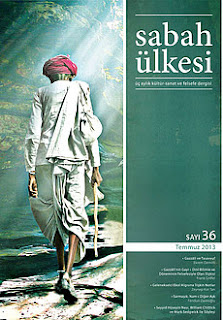
The current edition of Sabah Ülkesi is devoted to Traditionalism. Sabah Ülkesi is a quarterly magazine on cultural issues which is published in Turkish by the Islamische Gemeinschaft Milli Görüş in Germany and is distributed free to members.

Milli Görüş, "National (world-)view," is the second largest Islamic organization in Germany after the mosque associations affiliated to the Turkish Directorate of Religious Affairs, and has branches in some other European countries. It was traditionally affiliated to the political parties lead by the grand old man of Turkish Islamism Necmettin Erbakan (1926-2011), and since the decline of the last of these parties in the 2000s seems to concentrate on religious activities instead of Turkish politics.

The title of the magazine, Sabah Ülkesi, is a translation of Morgenland, a German term which is even more old-fashioned than 'Orient' and evokes the Arabian Nights and the infatuation of German poets with Persian and Arabic in the age of Romanticism. Apparently the purpose of this publication is to bolster the politics of the Milli Görüş movement with a broader cultural outlook and a more general critique of Western modernism. And who could serve this purpose better than Western critics of modernism? Thus the April issue of Sabah Ülkesi was dedicated to German Romanticism with Caspar David Friedrich’s iconic painting ‘Wanderer above the Sea of Fog’ adorning the cover, and a special issue on Traditionalism is the sequel to the Romanticism issue. This special issue was discussed on the cultural program of TRT, the Turkish state television channel (see this clip on YouTube). A description of it follows.

In a leading article, “Tradition and Traditionalism as a Social Sorting Device” (Gelenek ve Geleneksel Ayrıştırma Aracı Olarak Gelenekselcilik), Nuri Sağlam deplores how tradition has been juxtaposed to modernity whenever Muslims and Islam are dealt with so that Muslims can easily be denounced as fanatic and reactionary whereas in fact, in a world which is changing faster and faster, tradition can serve as an opportunity for liberation.

Other articles are dedicated to the protagonists of the Traditional school, in particular those who converted to Islam, as for example in the introductory article “Four Travelers Encountered on the ‘Eternal Journey’: Guénon, Schuon, Burckhardt and Lings…” (’Daimi Yolculuk’ta karşılaşmış dört Yolcu) by Melek Paşalı. Serap Kılıç describes in “Philosophia perennis and Its Manifestation in the Course of History” (Ezelî Hikmet ve Tarihî Süreçte Tezahürü) the Traditionalist idea that sacred knowledge based on a divine origin can be found in all authentic traditions. Zeynep Kot Tan addresses in her article “Notes Concerning the Perception of the Traditionalist School” (Gelenekselci Ekol algısına ilişkin Notlar) what should be the major problem for orthodox Muslims with regard to the Traditionalist school—that their approach relativizes the truth claims of any one particular religion—but defends Traditionalism against (unnamed) Muslim detractors who equate it to the ‘liberal-secularist’ idea that all religions are the same. Discarding such ‘reductionist concepts’ she claims that religions have within their very own framework instruments that allow them to attain truth.

In “The Knowledge of Being and the Being of Knowledge: The Understading of Being and Knowledge in René Guénon” (Varlığın Bilgisi Bilginin Varlığı: René Guénon’un Varlık ve Bilgi Anlayışı), Numan Rakipoğlu writes that Guénon rejected the subject-object distinction that characterizes most post-Cartesian Western philosophy, and adopted both Vedantic anti-dualism (advaita) and the Sufi concept of unity of existence (waḥdat al-wujūd) to express his point that there is no clear separation between subject and object because both are derived from Being. He leaves the shackles of Aristotelian logic behind him, and hence his approach is closer to that of wise men like Ibn ʿArabī, Qūnawī and Jīlī. His ideas contradict the nominalist concepts which underlie most of modern philosophical and scientific concepts.

The aspect of the ‘transcendental unity of religions’ is also dealt with, by Nurullah Koltaş in “A contemporary/ modern Wiseman: Frithjof Schuon and Traditionalism” (Çağdaş bir Arif: Frithjof Schuon ve Gelenkselcilik). Koltaş gives a brief account of Schuon’s life, and defends him against allegations of syncretism, even though he turned to Native American religion after having converted to Islam. Religions are not mixed together they are already one in their essence. Koltaş seems to be the most prominent of the special issue’s authors: he teaches philosophy at Trakya Üniversitesi and has published a book on the Traditionalist school and Islam (Glenekselci Evol ve İslam, Istanbul: İnsan Yayınları, 2013).

In another biographical article, Ercan Alkan addresses discusses “Titus Burckhardt: Traditionalism and Sufism” (Titus Burckhardt: Gelenekselcilik ve Tasavvuf) where he describes how Burckhardt traces back all aspects of Islamic art to the principle of tawḥīd. According to Alkan, Burckhardt saw Sufism as the internal direction and essence of Islam, and as a commentary on the Qurʾān.

The title of the article “Geleneğin sinemadaki izsürücüsü Tarkowski” is difficult to translate because it alludes to the title of the Russian director Andrei Tarkovsky’s most famous film: “The Stalker of Tradition in Cinema” sounds a bit odd in English. In this contribution, Özay Aslan alleges an intellectual affinity between Tarkovsky and the Traditionalist school. He refers to Tarkovsky’s book Sculpting Time where the director claims that “the East (i.e. the Easterner) doesn’t say a word about himself but loses himself in God, nature and time and reemerges in them.” However, Aslan does not claim or try to show that Tarkowski was influenced by the Traditionalist school.

Finally the issue contains three interviews, one with the leading Traditionalist Seyyed Hossein Nasr, and one each with Mark Sedgwick and William Chittick.

In his interview, Nasr declares that he became attracted to and finally convinced by Traditionalist thought because the Traditionalist school provided a critique of the modernist worldview which rests on the ‘first principles.’ According to Nasr it gives post-Christian Westerners an opportunity to rediscover their traditions, and can enable the Muslims who live as minorities in the West to defend themselves against the onslaught of secular ideologies. But for this purpose they also have to overcome the inferiority complex which Western colonialism has instilled into them. Unlike Japan, China or India, which have to various degrees adopted some form of Western modernism, the majority of Muslims remained devoted to their faith and thus remain an obstacle to western dominance. Islam also continues to be a whole way of life from which no single elements could be adapted. One cannot simply practice some aspects of Sufism like one can practice yoga, one has to become Muslim, and many in the West have done so.

William Chittick stresses right at the beginning that he does not want to be considered a Traditionalist or a member of any other ‘school.’ However, he confesses that when he was a student reading Schuon had a considerable impact on him because he did not believe in the ‘American Way of Life.’ Asked whether he thinks that other religions might contain some truths from which the Muslims might profit, Chittick answers that just as one first begins to reflect on one’s own language when one learns another one, people begin to reflect on their religion once they encounter another one. According to his experience they then return to their religion with even more conviction. In response to a question about why Sufism has become so popular in the West, Chittick states the many in the West encounter not only Islam, but also Christianity and Judaism in narrow-minded, fanatic form, but encounter Sufism as a message of love and mercy in the form of beautiful poems. However, one should not make the mistake of separating Sufism from Islam, from the teachings of the theologians and the regulations of the sharia. Chittick says he does of course not renounce such advantages of modernity as computers (although Illich has alerted us to the Medical Nemesis), but the people of earlier periods were far more aware of what it meant to be a human and of what God demanded from them. It was not only modernization and modernism which disrupted the connection between Muslims and their heritage: another factor was according to him the politicization of Islam.

Muazzez Tümay talks with Mark Sedgwick, whom she introduces as a scholar with a critical approach to Traditionalism, about “The other side of Traditionalism” (Gelenekselciliğin diğer yakası). Starting with the analysis that Traditionalism is Western philosophy cloaked in Islamic terms, the interviewer asks Sedgwick why he does not consider Guénon a Muslim although the circumstances of his passing away are well known. Sedgwick replies that it is for God to judge whether Guénon was a Muslim or not but that it is apparent that there is no major change in his writings between before and after his conversion to Islam. And this is the case because he wanted to discover the perennial philosophy which is our Urreligion. Sedgwick states that the Traditionalist critique of modernism has some aspects in common with Romanticism, but ‘Guénon was not Goethe’ and Traditionalism lacks the obsession with individualism and originality that characterizes Romanticism. Sedgwick also refuses to accept that other currents of Traditionalism have split off from ‘Islamic Traditionalism.’ As a scholar, it is not his task to say what true Traditionalism (or true Islam) is. In response to a question about why Traditionalism is so successful in Turkey although he has called it a ‘school for intellectuals,’ Sedgwick responds that historical experiences in Turkey and Russia were completely different from the West. This might explain why Traditionalism attracts far more interest there. Asked what motivated him to study Traditionalism, Sedgwick responds that in the beginning he was motivated because he himself found Traditionalism fascinating, and then he wanted to understand why others were fascinated by Traditionalism. After publishing Against the Modern World he thought that he had done his duty and could now address other subjects, but that was not possible because people continue to ask him about Traditionalism.

Sunday, February 12, 2012

Dugin in Turkey

A new article covers Dugin's Turkish contacts, with Doğu Perinçek and his İşçi Partisi (IP, Workers' Party). The article is by Martin Riexinger, "'Turkey, Completely Independent!' Contemporary Turkish left-wing Nationalism (ulusal sol/ulusalcilik): its Predecessors, Objectives and Enemies," Oriente Moderno 90, no. 2, pp. 353-95.

Riexinger explains that IP is one of two major organizations on the Turkish nationalist left. It generally receives few votes in elections, but its importance comes not from its electoral activities, but from the fact that it--like Türk Solu, the other major left nationalist group--draws its support from "members of the army, the bureaucracy, the academe and the professions." Thus for the Eurasia Conference it organized in 2004 it attracted the support of Süleyman Demirel and the presence of diplomats from the Turkic republics, China and Iran, as well as of the former head of the National Security Council, General Tuncer Kılınç.

The IP was established out of the Sosyalist Parti in 1992 by Perinçek, formerly the leader of the Türkiye İhtilalcı İşçi ve Köylü Partisi (Revolutionary Workers' and Farmers' Party of Turkey), and before that a Maoist student leader. The IP's leftism now consists primarily in the use of some Marxist terminology and a "keen interest in workers' and farmers' protests" (despite its middle-class membership), and its nationalism consists primarily in its stance against the threats that the US-dominated New World Order allegedly pose to Turkish independence, and thus also in opposition to the EU. In this Perinçek needs allies, and this is the basis of his relationship with Dugin, whose stand against the US and globalization Perinçek shares and supports.

The IP is generally anti-religious, seeing religion as reactionary, and drawing on European post-Feuerbachian criticism of religions. It thus has no interest in Dugin's Traditionalism, which in Turkey is associated with the Nakşibendis and the Nurcus, the latter of whom  are among the religious groups that the IP attacks. It also attacks the Islamists, Christian missionaries, and the Gülen movement, which emphasizes dialog with non-Muslims. Given the rapprochement between nationalist right and nationalist left that has already taken place, however, Riexinger considers that a future rapprochement between the nationalist left and some Islamists is not impossible, given that they both share the same enemies--the EU, the USA, missionaries, Jews, Freemasons, and homosexuals--and "subordinate the individual to the collective and ... cannot imagine something more horrible than a culturally heterogenous Turkey."

An interesting detail: Russian nationalists have generally been supporters of their fellow-Orthodox Greeks. Dugin, however, has supported Turkey rather than Greece in Cyprus, which has the important consequence of making him acceptable to Turkish nationalists, on the grounds that the Greeks are a maritime (and so an Atlantic) civilization rather than a Eurasian one.

Monday, June 07, 2010

Traditionalists in the AK

Omar commented: "Just wanted to remind you that Erdogans chief advisor is Ibrahim Kalin who is also a disciple of Seyyed Hossein Nasr. That means traditionalism is now at the core of a modern political movement, the AK Party."

Dr Ibrahim Kalin is Chief Foreign Policy Adviser to Prime Minister Recep Tayyip Erdoğan, and so certainly close to the AK leadership.

Dr Kalin of Turkish origin and is an assistant professor at the Walsh School of Foreign Service at Georgetown University in Washington, DC, where he works on post-Avicennan Islamic philosophy, notably Mullah Sadra; he has just published a book on Mullah Sadra's concept of "transcendent wisdom," Knowledge in Later Islamic Philosophy: Mulla Sadra on Existence, Intellect and Intuition (New York: Oxford University Press, 2010). Dr Kalin is also active in the Common Word initiative, which has been pursuing real dialog with Western churches since 2006.

I have often been told of interest in Traditionalism among the AK leadership, which would not be a great surprise, given the popularity in Turkey of the work of Dr Nasr. Dr Kalin seems very much to follow the model of Dr Nasr. Both men are of Muslim origin, both teach in DC and are authorities on "traditional" Islamic mystical philosophy, and both are active in the Common Word initiative.

My thanks to Omar for this information.

Friday, October 24, 2008

Dugin in plot to topple government of Turkey?!

Sometimes I think I need a separate blog just to report highlights of the activities (or alleged activities) of Alexander Dugin...

Now it is plots and Turkey. For anyone who hasn't noticed, 86 prominent Turks were charged in July 2008 with plotting to foment unrest with the ultimate aim of toppling the (mildly Islamist) AKP government of Turkey, as part of an ultra-nationalist network called Ergenekon. Opinion seems divided--some see Ergenekon as an attempt by a secularist group or even a "deep state" to finish off the AKP, while others see the charges as an attempt by the AKP to finish off some leading secularists and frighten off some others.

The latest twist in the story is the allegation that key Ergenekon members were closely associated with Russia, and that the link was Alexander Dugin. Those who see the charges as being mounted by the AKP against patriotic secularists naturally see these allegations as a further and baseless attempt to discredit those charged. Those who see contemporary Russia as having returned to the most aggressive practices of the old Soviet Union naturally see these allegations as yet another element in a worrying pattern.

Dugin has certainly met some of the Ergenekon figures, and there may even be some overlap of ideas. Whether there is any more truth to the allegations than this may become clear with time, since Turkish prosecutors are reported to be preparing to introduce evidence of Dugin's role in court at some stage.

Thursday, May 01, 2008

Alexander Dugin's Networks in Turkey

Key points from Marlène Laruelle's paper on "Russo-Turkish Rapprochement through the Idea of Eurasia: Alexander Dugin's Networks in Turkey," given at the Jamestown Foundation in Washington, DC, Tuesday, April 29, 2008:
  • The concept of concept of Eurasia (Avrasya) was developed independently in Turkey, and its exponents were initially critical of Dugin's Eurasianism.
  • This, however, has now changed. In 2003, the Turkish translation of Dugin's Geopolitics was published as Rus Jeopolitigi Avrasyaci Yaklasim, and according to Laruelle "seems to have gone over well with part of the Turkish military"--especially among "army officers disillusioned by Turkey’s loss of clout in NATO and shocked by the Iraq war."
  • Notable Turks who have participated in events or projects of Dugin's include
    • Suleyman Demirel, formerly president of Turkey
    • Rauf Denktash, at that point president of the Turkish Republic of Northern Cyprus
    • Kurtulus Taskent, Turkish ambassador to Russia
    • Abdulkadir Ates, representative of the Turkish delegation to the OSCE
  • Dugin's main supporter in Turkey is the Turkish Workers’ Party (Turkiye İşçi Partisi), a "small communist-leaning party."
  • Nothing concrete has yet come of this, though one day it might. A continuing aim is "an interparliamentary Eurasian assembly, including not only Russians and Turks, but also representatives of Iran and the Arab states."

Tuesday, September 25, 2007

Traditionalism in Turkey

A colleague tells me that Guénon is read with approval by many Nurcus--the followers of Said Nursi. A good fit, I think.

The same colleague also questions my view, expressed in Against the Modern World, that Traditionalism in Turkey is not political. On the contrary, he argues, it has major political implications as a voice against Western culture. This must be right--this is the role that everyone is agreed Traditionalism played in Iran before the revolution, so it could hardly not be the case in Turkey too.