Showing posts with label Romania. Show all posts

Friday, January 16, 2026

Traditionalism and Eastern Orthodoxy: Call for contributions

The reception of Traditionalism has been better studied in some contexts than in others. This Call invites proposals for chapters in a forthcoming multi-author book to be entitled The Reception of Traditionalism in Eastern Orthodoxy: Mysticism and Politics, edited by Mark Sedgwick. Contributors will be invited to an authors’ workshop in Belgrade in March 2027 to discuss pre-circulated drafts (expenses covered by the organizers).

Topics to be covered include: Traditionalism in interwar Romania: Mircea Eliade and his circles; Traditionalism in Yugoslavia and Serbia; Eastern Orthodox Traditionalism in the West: James Cutsinger, Philip Sherrard, and John Tavener; Traditionalism in late-Soviet and early post-Soviet Russia; Traditionalism in Ukraine, Belarus, post-Communist Romania, and b; Aleksander Dugin and the development of Traditionalist Eurasianism; and perhaps also Traditionalism in Bulgaria, Moldova, and/or Georgia.

Chapters should cover the reception of Traditionalism in the country(ies) and period(s) in question, explaining who transmitted and developed Traditionalist thought, what aspects were stressed, glossed over, and further developed, and how this relates to the context of the place(s) and time(s).

Brief proposals (500 words), including a proposed title, should be sent to Mark Sedgwick (mjrs@cas.au.dk) before midnight CET on February 15, accompanied by a biographical note that mentions relevant prior publications. Feel free to send more than one proposal. On the basis of these proposals, actual chapters will be commissioned as soon as possible, to be researched and drafted before March 2027.

The authors’ workshop will refine the drafts and allow us to discuss how the reception and development of Traditionalism in Eastern Orthodoxy differs from what happened in the Catholic and Protestant West, and in Latin America, and to explore what this tells us about Traditionalism, mysticism, politics, and Eastern Orthodoxy.

“Traditionalism” as used in this Call refers to those working with the idea of an esoteric primordial tradition as developed by René Guénon. The book will not cover forms of traditionalism that have no connection with Guénon.

This project is funded by the Templeton Religion Trust through the Program in the Study of Mysticism (PRISM) at Tampere University, Finland.

Monday, July 21, 2025

More on André Scrima

The Romanian historian of religions Bogdan Tătaru-Cazaban has recently contributed to the discussion of the status of Traditionalism for the Romanian monk and theologian André Scrima (1925-2000), discussed in previous posts here and here, with an excellent article, “The Inner Dimension of the Orthodox Tradition and Traditionalism According to André Scrima’s Hermeneutics,” Review of Ecumenical Studies 12:3 (2020): 485-496, available here

Tătaru-Cazaban takes us further into the original sources (1958, 1994, and 1996) and maintains the position taken by others that Scrima was not really a Traditionalist, given the various points on which he criticized Traditionalist positions. “His detachment from Traditionalism appears evident,” writes Tătaru-Cazaban.

The article is well argued, but I am not entirely convinced that the detachment is realty that evident. Scrima wrote a preface to a Romanian translation of Schuon’s De l’unité transcendante des religions in 1994, when he was 69 and approaching the end of his life, which suggests that he still valued Schuon’s work, even if he disagreed with it in certain ways. It all depends, perhaps, on what one means by “Traditionalist.” If one means “absolutely faithful to the positions taken by Guénon and Schuon,” there are very few real Traditionalists, especially since Guénon and Schuon themselves disagreed on various points. If one means “someone whose starting point was in Traditionalist thought and who then developed and modified that thought,” Scrima was perhaps a Traditionalist.

Tătaru-Cazaban finds “two invariable aspects” in Scrima’s hermeneutics. One is that “tradition is a transmission of living knowledge and of the access to an experience of the Living God through his Holy Spirit; it is not only a ‘repository’ of the experience of faith.” The other is that “Hesychasm is not an ‘universalizable’ spiritual tradition without Christ.” Hesychasm, the ritual pursuit of stillness (Greek hēsychia), is a collection of spiritual practices that developed in the Orthodox church in the fourteenth century, and was revived in Romania in the 1940s by a group of monks including Scrima who were inspired by Traditionalist understandings of the esoteric

To see tradition as a transmission of living knowledge rather than as a historical repository is not necessarily a detachment from the Traditionalist position. Although the way that some Traditionalists find the tradition in ancient texts might seem to turn it into a sort of repository, any Traditionalist who follows a Sufi shaykh also sees the tradition as a transmission of living knowledge. The one position does not exclude the other. One can read ancient texts and following a living master. Similarly, although some perennialists might universalize a practice such as Hesychasm stripped of its context, most would not: Guénon ended by stressing the importance of the exoteric context for any esoteric practice, following the Sufi approach that emphasizes the sharia as the contained of the haqiqa.

When it comes to the relationship between the esoteric and exoteric, Scrima did perhaps detach himself from the Traditionalist position, to judge from passages quoted by Tătaru-Cazaban, here translated by me from French to English:

Spiritual life has always been conceived in the Eastern Church as a living transmission, a parádosis, conveying the Spirit incarnate… There is no room here for any conflict of importance with the Tradition of the Church as such, nor for any distinction of nature from it… The distinction, itself external, between esoteric and exoteric, is meaningless here, for it is no longer a hidden continuation that denies time, a sacred passage, but a continuation of Presence.

Scrima, then, rejected the absolute distinction between the esoteric and the exoteric that is central to Traditionalism, especially in Guénon’s early work, though he later softened this position, and Schuon further eroded the distinction. Scrima, however, emphasized throughout his life the Hesychast practice that he and others saw as corresponding to Guénon’s understanding of the esoteric.His position here, then, is best seen as a modification, not a rejection.

Sunday, October 13, 2024

Michel Vâlsan and Anton Dumitriu

The Romanian antiquarian “Historic Paper Treasures & Collectibles” is selling seven letters and notes from Michel Vâlsan (Mustafa 'Abd al-'Aziz) to Anton Dumitriu (1905-1992).

Vâlsan, editor of Etudes Traditionnelles and a Shadhili shaykh in Paris, was originally Romanian but left Romania forever during the Second World War. Dumitriu was also a Romanian Traditionalist but remained in Romania. He taught philosophy at the University of Bucharest until 1948, when he was arrested by the new Communist government, but was able to return to academic work in 1964, and even to travel abroad. 

Dumitriu was known publicly as an expert in logic, but his real interests seem to have been esoteric, moving from Theosophy to Traditionalism. According to the contemporary Romanian Traditionalist Vasile Zecherum (see here) he was a member of a Christian Orthodox mystical group at the Antim Monastery called “Rugul aprins” (the Burning Bush) and also a Freemason. In one of the letters on sale, Vâlsan is responding to a letter from Dumitriu about Orthodox esotericism. Many of Dumitriu's books were on logic, but his Orient și Occident (East and West) of 1943 engages polemically with René Guénon, one of whose books gave Dumitriu his title, and his late work Homo universalis. Încercare asupra naturii realității umane (Homo universalis: An essay on the nature of human reality), 1990, is very much within the Traditionalist frame—and neatly summarized by Zecherum here.

Some of the correspondence is of no great interest—a Happy New Year card, for example. Three letters in French are of more interest. A letter of 1967 deals with sending books, and perhaps marks the re-establishment of contact between the two men after a long break A letter of 1968 deals with Orthodox esotericism, as already mentioned. Finally, in a letter of 1971 Vâlsan explains why he cannot immediately contribute to what seems to have been a proposed series on Ibn Arabi and other Arab esotericists. The 1971 letter uses the familiar “tu” form, so Dumitriu had probably visited Paris and met Vâlsan in person between 1968 and 1971. In general, there seem to have been more letters from Dumitriu to Vâlsan than the other way round.

Dumitriu, then, should be added to the list of active Traditionalists. It is surprising that the Romanian Communists did not object to his Traditionalism, which they must have been aware of. Their tolerance, however, had limits. His Homo universalis was not published until after the end of the Communist regime.

The letters are available here for 600 Lei ($130) and the front page of each can be read on the website for free if you open the image in a new tab.

My thanks to AC for directing me to this small trove.

Wednesday, August 02, 2023

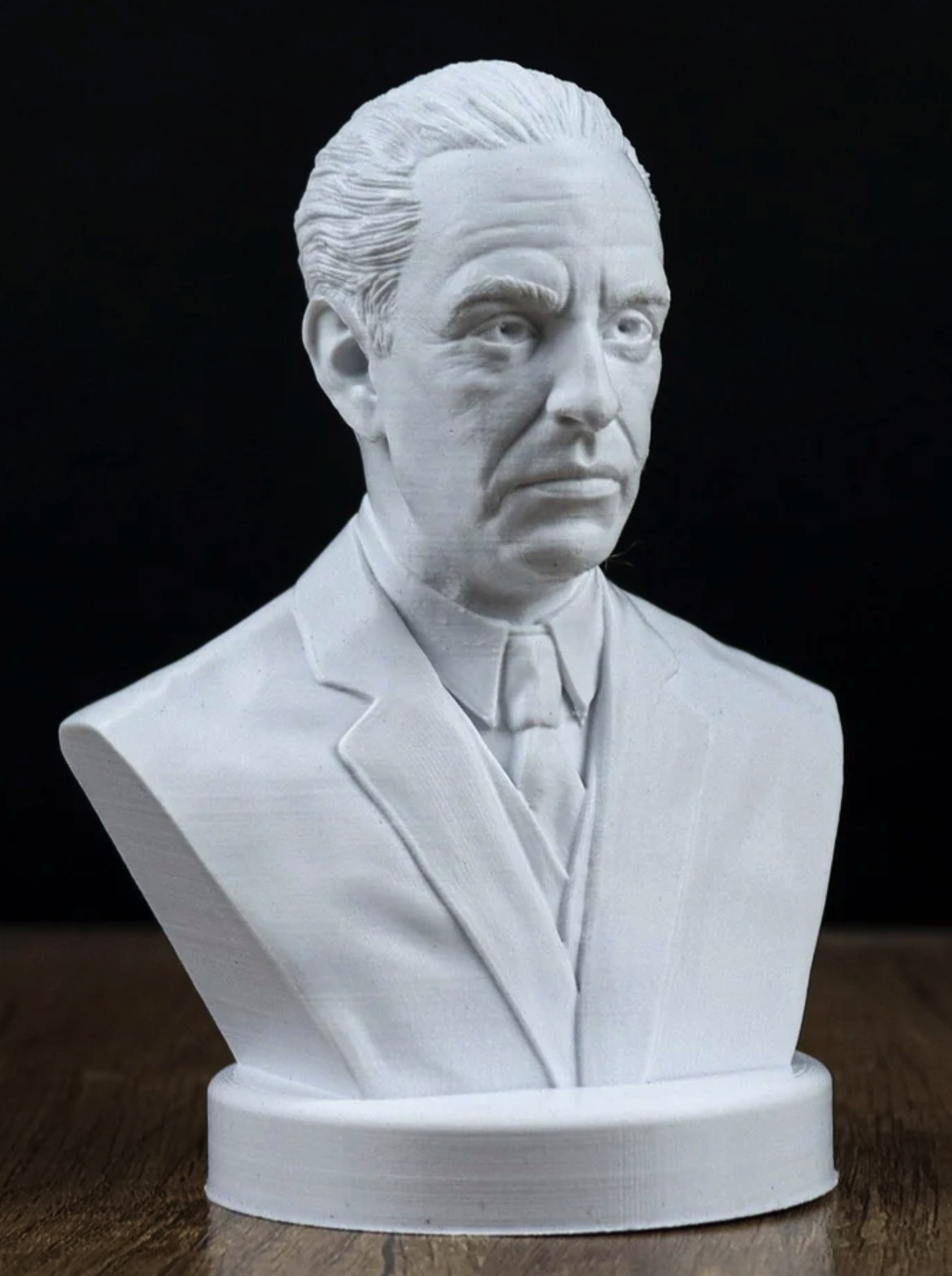
Evola merch

Evola T-shirts have been available for some time from several suppliers, including the online marketplace Redbubble in the US, who also sell mugs against the modern world, and Motpol in Sweden. Now Evola busts are also on sale. There are currently two suppliers. ProperCrafts in Romania will sell you a bust (see photo) made in a special eco-friendly plastic, in varying heights and colors. Heretic Camp in Ukraine will sell you an enameled plaster bust. ProperCrafts seems to be a commercial venture, and can also sell you busts of Mussolini, Julius Caesar, Boris Johnson, and Joe Biden. Heretic Camp specializes in Black Metal Music tracks, and busts are a sideline. It seems to be connected to the Azov Brigade.

My thanks to AK for pointing me to ProperCrafts.

Friday, January 04, 2019

Panel on Traditionalism at European Academy of Religion

There will be a panel on "Dynamics of Local and Global Reception of Traditionalism: Reconsidering the Heritage of René Guénon" at the 2019 Conference of the European Academy of Religion, to be held in Bologna, Italy from Monday 4th to Thursday 7th March, 2019.

The panel is on March 7, 16:45-18:45.

Panel abstract:
One of the most influential Philosophers of the 20th century, René Guénon (1886-1951) has left a rich heritage, whose intricate history and ramifications are only beginning to be studied. The aim of this panel is to present some cases of this heritage, insisting on the local factors modeling its reception, as well as on its adaptation to metapolitical and global concerns. Attemptive typologies of the complex reception of Traditionalism will also be proposed and discussed. 
Chair: Ionuţ Daniel Băncilă (University of Erfurt)

Panelists:
  • Marco Giardini (Independent Scholar) - The Journal “L´Ultima” and the Reception of René Guénon in Catholic Italy
    The journal “L'Ultima” occupies a special place in the landscape of Catholic thought between Second World War and the Second Vatican Council, although it has been surprisingly neglected by the majority of scholars of Church History of History of Religions. Marked by a strong eschatological vocation, it gathered several authors who proposed original interpretations of Catholicism inspired by the “traditionalist” current that was taking shape in the mid-twentieth century around the works of René Guénon. In particular, contributors such as Attilio Mordini (1923-1966) and Silvano Panunzio (1918-2010) wrote a considerable amount of articles in which the main aspects of Christian doctrines re-interpreted in line with the metaphysical and cosmological principles that these authors “discovered” in Eastern traditions through the works of Guénon and his first followers. The paper intends precisely to highlight some aspects of Mordini and Panunzio's writings for “L'Ultima” in order to assess the original aspects of what may be called the first organic reception of Guénon's works within Italian Catholic circles, in a way that reveals a very positive stance to the “traditionalist” current in contrast to various forms of criticism leveled to the French metaphysician in previous decades.
  • Ionuţ Daniel Băncilă (University of Erfurt) - A Typology of Romanian Traditionalism
    While the reception of R. Guénon in Romania reached its peak in 30es, not one single profile of the intellectuals involved in this process (M. Avramescu, M. Valsan, V. Lovinescu, A. Dumitriu) was like the other. My paper aims to give these and other actors in this complex reception process their proper historical and cultural contextualization, but also to discuss affinities of other individuals and groups with guénonian thinking. Later reception of Guénon through the reading-group established by V. Lovinescu at the end of the 50es and its reactivation under different auspices after the fall of the Communist regime will also be discussed. The individual intellectual profiles marked by the thinking of Guénon are then to be summed up in a tentative typology of his reception in Romania.
  • Marco Toti (Independent Scholar) - Metapolitics as Esotericism Through Geopolitics. A. Dugin and C. Mutti’s Eurasian Perspective
    This paper aims to focus on the so called “Eurasian perspective”, by way of analyzing some of the most significant topics endorsed by two of its most important spokesmen, the Russian A. Dugin (1962-) and the Italian C. Mutti (1946-): their major sources and essential geopolitical purposes, with special reference to the “heterodoxically metapolitical” rereading of Guénon and Evola, “revised” through a wide spectrum of assorted ideological insertions. In particular, the paper aims to clearly distinguish their perspective from American “apolitical” perennialism (H. Smith, J. Cutsinger). This does not mean that the respective Weltanschauungen could not often converge, although “metapolitical purposes” are irrelevant to the latter. The main point, as we understand it, is the relationship between metapolitics and "pure metaphyscs".

Sunday, April 29, 2018

New research project on Romanian Traditionalism

Guest post by Alin Constantin (Stanford), blue_socking@yahoo.com

The new research project in which I am engaged has been a result of my own engagement with the legacy of interwar Romanian culture. I started reading into the history of Traditionalism and its representatives after finding out about Mircea Eliade’s association with this line of thought. This connection between Eliade and Traditionalism has played a significant role in the reception of post-communist religious thought in Romania. The publisher which has published Eliade’s work since the nineties, Humanitas, has also been responsible for introducing the Romanian public to the works of Guénon, Schuon and Evola, and—more recently—Aleksandr Dugin. Although Eliade was not a Traditionalist thinker, he was definitely influenced in certain respects by Coomaraswamy, Guénon and Evola.

Since the 1990s, a growing interest on the part of the Romanian reading public has been focused on the rediscovery of interwar intellectual culture. This interest was not, as it might be expected, a reaction to the limitations of official communist historiography, a desire to discover what had previously been hidden and condemned. In fact, interest in the period had already been underway in the last decades of communist rule, which were characterized by a strongly nationalistic political bent. As a result of this rightward turn, many writers and thinkers who been associated with the interwar far right were now being reintroduced in the cannon of officially endorsed representatives of Romanian culture. If anything, in the post-communist period this practice has been followed through rather than begun anew.

Previous researchers working on Eliade and Romanian Traditionalism have focused on published works. While valuable in many respects, such accounts cannot provide a comprehensive history of the movement. For this one needs to go into the archives. Yet how does one investigate a movement that kept itself purposefully hidden from view? The record here is mixed. Eliade kept a detailed collection of his drafts, manuscripts, diaries and correspondence. His archives are held in the University of Chicago Library. His collection of books was destroyed in a fire shortly before his death. One is thus unable to glean information on his reading habits during his American years. His Parisian library, however, has been preserved entirely. This contains books he had brought from Portugal, volumes he purchased or received as a gift in France, as well as books from Chicago which he brought along as reading material when he came back to Europe on holiday. This valuable collection was housed in a branch of the Metropolitan Library of Bucharest, the Nicolaus Olahus Warehouse. Unfortunately, the whole of Eliade’s books have been transported from this library in February of this year, supposing to be relocated to another branch by March. As of yet, this has not happened and the move seems to be in limbo.

The Nicolaus Olahus Warehouse also possesses a collection of manuscripts which belonged to Vasile Lovinescu and Michel Valsan, two of the leading representatives of Romanian Traditionalism. A diplomat by profession, Valsan did not return to Romania following the end of WWII and settled permanently in France, becoming the editor of Études Traditionnelles. Lovinescu on the other hand remained in Romania, alternating his time between the provincial town of Fălticeni and Bucharest. Lovinescu depended on friends from abroad such as Valsan for receiving books he could not get hold of. Lovinescu was closely monitored by the communist secret police, the Securitate, and his correspondence with Valsan is available in its archives. Other libraries in Bucharest also hold important material pertaining to the subject. The Library of the Romanian Academy holds copies of Memra: Studii de tradiţie ezoterică, the first (and only) Romanian Traditionalist journal, published in the 1930s.

The resources for the study of Romanian Traditionalism are rich, and their investigation can considerably advance our understanding of the movement, from both a national and transnational perspective.

Friday, September 26, 2014

Traditionalist postage stamp

Only just found: the world's only known Traditionalist postage stamp.

Issued by the Moldovan Post Office (Posta Moldovei) in 2007, a series of three stamps featured the Romanian playwright Ion Luca Caragiale (1852-1912), the Moldovan opera singers Anastasia Dicescu (1887-1945) and Maria Bieșu (1935-2012), and Mircea Eliade (1907-1986).

Inset in the Eliade stamp, shown here, are two well-known photographs of Eliade, the covers of two of his better known books (The Myth of the Eternal Return and the History of Religious Ideas), and--less predictably--a photograph of Guénon and Schuon in Cairo.

The stamp was designed by Elena Karacenţev (b. 1960), a Moldovan artist who grew up in what was then Leningrad, and so perhaps discovered Eliade in a Russian version.

Saturday, February 19, 2011

New article on the work of Andrei Scrima

Marco Toti, author of the paper that first drew attention to the Romanian Traditionalist Andrei Scrima (1925-2000, see earlier post here), has now published an article on Scrima's thought and writing, "Religious Morphology, Hermeneutics and Initiation in Andrei Scrima’s Il padre spirituale (The Spiritual Father)," Aries 11.1 (2011), pp. 77-97.

After a complex and nuanced discussion, Toti concludes that Scrima was not so much a hard Traditionalist (in the sense in which I use the adjective) as someone who "recovers, develops, deepens and recontextualizes some typical ‘traditionalist’ themes—softening, for example, the ‘mathematical’ orientation given by Guénon to them, and placing in his treatment poetic and philosophical motives which are completely irrelevant to the French metaphysician" (p. 94). This is much what Patrick Ringgenberg concluded in the case of Schuon (see earlier post here).


Scrima's life is not Toti's main subject, but he notes, interestingly, that Scrima was "one of the ‘inspirers’ for the establishment in Bucharest of the ‘New Europe College’, an institute for advanced studies in humanities founded in 1994 by Andrei Pleşu, former Foreign Minister and Minister of Culture of the Republic of Romania" (p. 78). The name of Pleşu has featured before in the history of Traditionalism in Romania.

Sunday, July 08, 2007

New Romanian Traditionalist of interest

Marco Toti, in his paper on "La globalisation du ”traditionalisme”. Quelques tendances de la philosophia perennis (États-Unis, Roumanie, Italie)" (given at the CESNUR conference in Bordeaux, June 7-9, 2007) has drawn attention to a previously unnoticed Romanian Traditionalist, or at least semi-Traditionalist, Andre Scrima (1925-2000).

In his youth Scrima was a member of Rugul Aprins, a group of Romanian monks and laymen considered by Michel Vâlsan to be an authentic form of Christian esoterism. Later, Scrima attended the Second Vatican Council as an observer on behalf of Archbishop Athenagoras of Constantinople, the Ecumenical Patriarch of the Orthodox Church.

Toti's main source is E. Montanari, La fatica del cuore. Saggio sull’ascesi esicasta (Milan, 2003), pp. 117-128. He is publishing an article, "Morfologia religiosa ed ermeneutica nel "Padre Spirituale" di A. Scrima," in Studi e Materiali di Storia delle Religioni 74, no. 1 (2008).

Comments welcome: Marco Toti, marco76toti@yahoo.it