Showing posts with label Ukraine. Show all posts

Wednesday, August 02, 2023

Evola merch

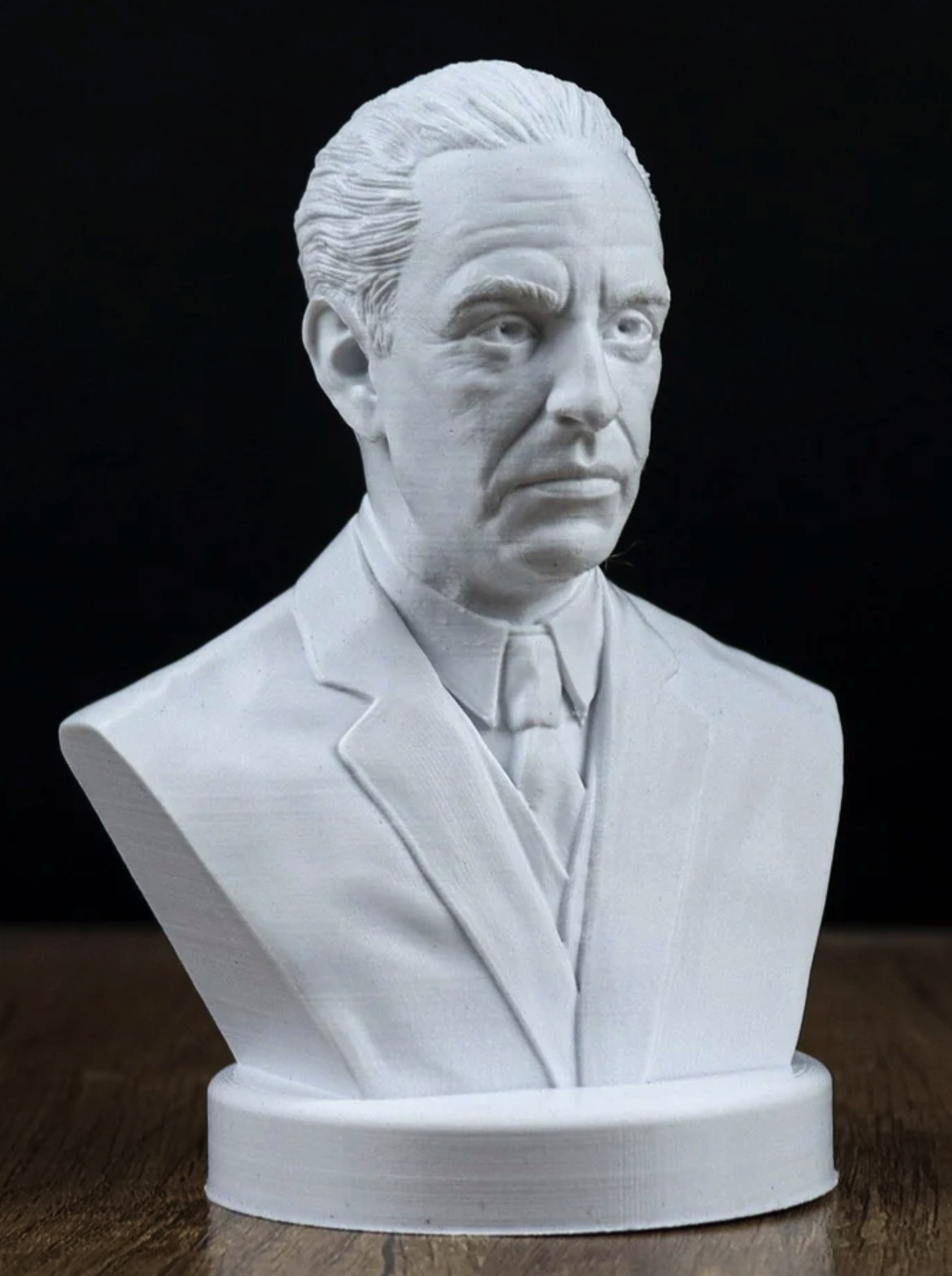
Evola T-shirts have been available for some time from several suppliers, including the online marketplace Redbubble in the US, who also sell mugs against the modern world, and Motpol in Sweden. Now Evola busts are also on sale. There are currently two suppliers. ProperCrafts in Romania will sell you a bust (see photo) made in a special eco-friendly plastic, in varying heights and colors. Heretic Camp in Ukraine will sell you an enameled plaster bust. ProperCrafts seems to be a commercial venture, and can also sell you busts of Mussolini, Julius Caesar, Boris Johnson, and Joe Biden. Heretic Camp specializes in Black Metal Music tracks, and busts are a sideline. It seems to be connected to the Azov Brigade.

My thanks to AK for pointing me to ProperCrafts.

Sunday, March 27, 2022

Dugin and Ukraine

Since the Russian invasion of Ukraine, there have been ever more mentions of the Russian Traditionalist (or possibly post-Traditionalist) Alexander Dugin in the Western press. The general view is, as the Washington Post recently put it, that President Putin’s “analysis came directly from the works of a fascist prophet of maximal Russian empire named Aleksandr Dugin,” and that “Russia has been running his [Dugin’s] playbook for the past 20 years.” “The recent invasion of Ukraine is a continuation of a Dugin-promoted strategy for weakening the international liberal order,” argues an article in Foreign Policy.  Dugin is “the most influential thinker in Russia,” according to Haaretz.

Is this true? Dugin certainly backs the invasion of Ukraine, which fits with his vision in many ways. But did he inspire that invasion? In a Facebook post on this question, Sindre Bangstad, a prominent Norwegian scholar of the radical right, argued that Dugin’s “influence in the Kremlin and on Putin is not known - precisely due to the fact that it is ultimately unknowable to outsiders.”  

Yes and no. Some things are unknowable to outsiders, or even insiders, but it is clear that Dugin is not one of Putin’s close advisors, and it is also clear that the general thrust of his geopolitical analysis is far from exclusive to him. Dugin did not invent Eurasianism, but rather refined it, in part by combining it with Traditionalism. Eurasianism was invented by earlier Russian thinkers, notably the linguist Prince Nikolai Trubetzkoy (1890-1938), and arose in the context of the debate between Westernizers and anti-Western Slavophils that is almost as old as the Russian state itself. Trubetzkoy’s Eurasianism was prefigured in the work of the Slavophil philosopher Konstantin Leontiev (1831-91), who saw the West as both a moral and military threat to Orthodox civilization and to Russia.

The Westernizing position recently had its day in Russia under President Yeltsin, and has been losing ground ever since. Putin is clearly in the anti-Western Slavophil camp, and is even said to have been reading Leontiev. The current prevalence of anti-Western and Slavophil positions in Moscow certainly helps explain the invasion of Ukraine, as Jane Burbank, a historian of Russia from New York University, recently argued in The New York Times. Burbank also proposed that “Eurasianism was injected directly into the bloodstream of Russian power in a variant developed by the self-styled philosopher Aleksandr Dugin.” This is more likely. Dugin has certainly made Eurasianism better known, and his variant is better adapted to today's world than variants from a century ago. But Dugin is a participant in a broad discussion, not the sole author of any playbook.

There is a tendency, in the West and elsewhere, to explain the actions of opponents in terms of unfamiliar and apparently bizarre ideologies. The anti-Westernism of revolutionaries in the Middle East, for example, is often blamed on Islamism or even Islam. Yes, Islamism matters, but Western policy and interventions in the Middle East since the end of the Second World War also matter, but it is harder to blame those interventions—which would mean the West blaming itself—than to blame Islamism. John Mearsheimer, a political scientist at the University of Chicago, argues that Western policy towards Russia is to blame for the current crisis. In his response to a recent article by Mearsheimer in The Economist. Sir Adam Roberts, an emeritus professor of international relations at the University of Oxford, called this argument “apparently perverse”—but then went on to demonstrate that there were also other reasons for the invasion of Ukraine, not that Mearsheimer was actually wrong.  Mearsheimer is at present something of a lone voice in blaming the errors of Western policy. It is a lot easier to blame “a fascist prophet.”


Thursday, July 06, 2017

Evola in the Ukrainian parliament

Ukraine needs to be added to the list of countries where a political party inspired by Julius Evola is represented in parliament. The party in question is the National Corps (Національний корпус) of Andriy Biletsky (Андрій Євгенович Білецький, pictured). It currently has only two seats, but it does have its own militia, the Azov Regiment, a volunteer unit now under the umbrella of the Ukrainian National Guard that operates against pro-Russian forces in the eastern Ukraine.

The National Corps also has an international relations section headed by Elena Semenyaka, a young political scientist whose academic specialization is the Conservative Revolution. Semenyaka was previously identified with Alexander Dugin and the Russian Eurasianists, but since Dugin and his Russian followers support the pro-Russian forces in the eastern Ukraine, Semenyaka and her colleagues are now engaged in trying to steer the European right away from Russia towards an “Intermarium Union” that aims to unite Ukraine with other eastern and central European countries, in effect a rightist version of the Visegrád Group. The Intermarium Union takes its name from a plan developed by the interwar Polish prime minister, Marshal Józef Piłsudski.

Interest in Evola in Ukraine is not restricted to the National Corps. It also includes members of Plomin’ (Пломінь, Flame), a “literary club” in Kiev that meets for lectures on philosophers and political thinkers, notably Evola and the thinkers of the Conservative Revolution.

Sunday, February 05, 2017

Another book on Eurasianism

Alexander Dugin and Traditionalism are discussed in a new collection edited by Mark Bassin and Gonzalo Pozo, The Politics of Eurasianism: Identity, Popular Culture and Russia's Foreign Policy (London: Rowman and Littlefield, 2017).

The book takes "Eurasianism" in its widest sense, and Dugin's Eurasianism--what some call "Neo-Eurasianism"--is thus only one of the topics considered.

The book is divided into four parts.

  • Part I, on "Eurasianism, Nationalism and Ideology," contains three chapters discussing Eurasianism in general terms. 
  • Part II, "The Cultural Politics of Eurasianism," contains three chapters looking at the status of Eurasianism in post-Soviet Russian life, as "alternative history" and in movies. 
  •  Part III looks at "'Project Eurasia' and Russia's Foreign Policy," and contains four chapters. Marlene Laruelle asks how Eurasianism sees China,  Gonzalo Pozo looks at the Eurasian Economic Union, Anton Shekhovtsov looks at "Aleksander Dugin's Neo-Eurasianism and the Russian-Uranian War," and Richard Sakwa looks at whether Eurasia really exists
  • Part IV looks at Eurasianism outside Russia: In Tartarstan (Victor Shnirel’man), Hungary (Balázs Trencsényi), Turkey (Emre Erşen), Kazakhstan (Luca Anceschi) and Germany (Ian Klinke on Alexander Rahr). 
Traditionalism is discussed explicitly only by Balázs Trencsényi, who notes its importance for the post-1980s alternative intellectual milieu in Hungary that drew on the work of Béla Hamvas, and the importance of this milieu and of Traditionalism for the Jobbik leader, Gábor Vona. This, in the view of Trencsényi, is one reason why Vona and Dugin see eye to eye. Another reason, he suggests, is that there is some evidence of Russian financial support for Jobbik. Trencsényi, incidentally, wrongly identifies Guénon as "an adherent of fascism."

Dugin is discussed especially by Shekhovtsov and by Erşen. Shekhovtsov shows that Dugin has long argued for the division of the Ukraine, explicitly in Foundations of Geopolitics (Основы Геополитики, 1997), but it is not clear to what extent he has actually played an important role in the recent Russian intervention. As Shekhovtsov reminds us, members of the Eurasian Youth Union (Евразийский Союз Молодежи, ESM) were early supporters of the secession of eastern Ukraine and established several branches there, but after their role in the spectacular destruction of Ukrainian national symbols atop Mount Hoverla in 2007 (see blog post), they suffered a split, were targeted by the Ukrainian security services, and declined in Ukraine. Other secessionists remained on good terms with Dugin, however, and when secessionism re-emerged after 2014, Dugin supported secession in his public pronouncements, and also encouraged ESM members to volunteer for action. So, however, did many other groups, and thus, as Shekhovtsov says, it "seems impossible to establish how successful or efficient the ESM was in recruiting the volunteers."

Interestingly, Shekhovtsov refers to a report by the Center for Economic and Political Reform, a Russian NGO, which shows Russian state financial support for the ESM (report available here). Dugin is often said to be close to the Russian state, but this is just as often disputed. Financial support for the ESM is evidence of a good working relationship. Sakwa, however, argues that Dugin’s "influence on Russian regime politics has been minimal" and notes that after his “militant and uncontrollable support for the insurgency in the Donbass," the Russian regime “fought back to control the monster of Russian nationalism." This makes sense: the Russian government undoubtedly wishes to use nationalism and Eurasianism, not be be used by it.

Erşen also considers Dugin's influence in Turkey. He covers familiar ground, and makes an important point: that while Dugin's anti-Westernism easily finds an appreciative audience in today's Turkey, his pro-Russianism does not.

Thursday, March 26, 2015

Washington got the wrong man?

In an article just published in Foreign Affairs, "Scared of Putin's Shadow," Marlene Laruelle argues that "in sanctioning Dugin, Washington got the wrong man."

Dugin, she argues, is not that important, and neither is ideology. "By putting Dugin ... on the sanctions list, the United States is essentially conveying that it ... truly believes that nationalistic ideology is the dominant motivation for Russia’s position on Ukraine. If that is correct, then the United States dangerously misunderstands Putin’s strategy ... Moscow’s involvement in Ukraine is primarily strategic."

Wednesday, March 11, 2015

Dugin sanctioned

By RFE/RL March 11, 2015

"The United States has issued a new list of individuals and entities to be sanctioned over Russia's interference in Ukraine, including Kremlin-connected nationalist ideologue Aleksandr Dugin and former Ukrainian Prime Minister Mykola Azarov.

"The Treasury Department on March 11 also sanctioned a bank in Crimea -- the Russian National Commercial Bank -- two other former officials from the government of ousted Ukrainian President Viktor Yanukovych, eight Ukrainian separatists, and two other leaders of Dugin's Eurasian Youth Union.

"Any U.S. property held by those individuals is frozen, and U.S. citizens are prohibited from doing business with them. The United States took the action to "hold accountable those responsible for violations of Ukraine’s sovereignty and territorial integrity." Russian FSB chief Aleksandr Bortnikov, who has been targeted by sanctions in the EU and Canada, was not on the list of individuals targeted by the Treasury Department in this latest round of sanctions."

Friday, October 14, 2011

Round-table on "Traditions and Traditionalism," Donetsk National Technical University

Another conference, or rather a round table, on "Traditions and Traditionalism," scheduled for November 11, 2011, at the Donetsk National Technical University, Ukraine. The Call follows normal academic protocol, and the round table is sponsored by the Department of Philosophy and the Center for Religious Studies, but is actually organized by a group called Aghlaqin that describes itself as "Thelemic"--i.e. inspired by Aleister Crowley. Conference languages are announced as Ukrainian, Russian and English, but the Call is only in Ukrainian.

There seems to be quite an interest in Tradititionalism in Ukraine. One of the websites carrying the Call is that of the Ukrainian Traditionalist Club, based in Kiev.

Wednesday, November 07, 2007

Dugin accused of "terrorism"

Alexander Dugin's Union of Eurasian Youth (Евразийский Союз Молодежи, ESM) has been accused of three acts of terrorism directed against the Ukrainian government in recent weeks.

The immediate context for this is a worsening of relations between Russia and Ukraine after Ukrainian President Viktor Yushchenko decided in mid October to elevate the members of the Ukrainian Insurgent Army, active during the Second World War against both German and Soviet forces, to the status of national heroes.

  • On October 18, ESM activists climbed Mount Hoverla in the Carpathians. Mount Hoverla is Ukraine's highest mountain, and a national symbol. The ESM activists destroyed some Ukrainian monuments, unfurled the Eurasian flag, and renamed the mountain "Mount Stalin." See photos.

  • On October 30, the ESM launched attacks against the website of the Ukrainian president.

  • On November 2, the Ukrainian security service (SBU) seized explosives from a left-luggage office at Simferopol railway station. According to the SBU, ESM activists intended to use the explosives on November 4, Russia's Day of National Unity.
These ESM accepted responsibility for the first two of these "actions," and has not yet commented on the third.

The first action was described as vandalism. The second might be called either vandalism or cyberwarfare (see "Estonia and Russia: A cyber-riot," The Economist, May 10th 2007). The third, because of the presence of explosives, would probably be called terrorism.

In fact, from the perspective of terrorist theory, the distinction between vandalism and terrorism is relatively unimportant. The political objectives of the use of violence are the same, whatever the type of violence, and whether the violence is used against property or persons. Blowing people up, of course, involves playing for higher stakes than climbing mountains.

It is not known whether or not the ESM was intending to use explosives against persons, but the violence of its "actions" may be increasing and tending in that direction.
  • Escalation from vandalism against property to attacks on persons is a pattern familiar to terrorism analysts. The Baader-Meinhof gang started off by attacking a department store, for example.
  • Fully-fledged terrorist groups have been inspired by Traditionalism before, in Italy in the 1970s.

Tuesday, January 16, 2007

Eurasianists in Ukraine

Late update:

In April 2006, Andreas Umland reported that a Ukrainian party connected with Dugin's Eurasia Movement had fallen just short of the 3% threshold for entering the Rada. Read more here.